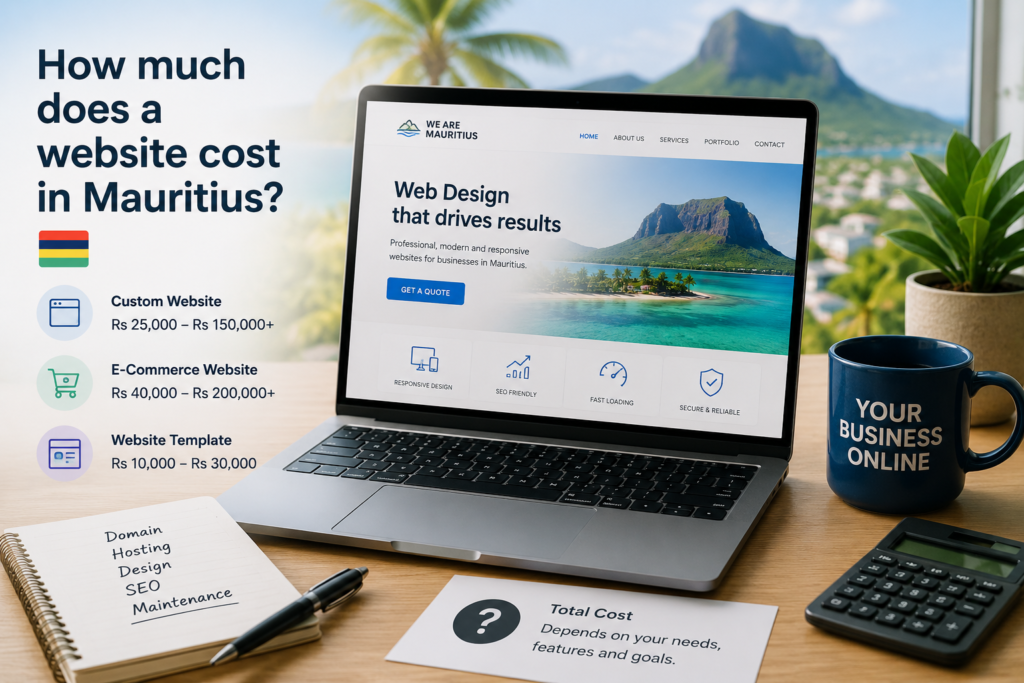
Choosing a company for a website design in Mauritius is rarely just about comparing prices. Two quotations that appear similar can differ significantly in terms of quality, long-term costs and the value they deliver to a business.
Some websites are built from inexpensive templates with little room for future growth. Others are carefully planned around business objectives, user experience, search engine visibility and ease of management. At first glance, both may look professional, yet the results they generate over the coming years can be completely different.
For business owners in Mauritius, understanding what is included in a website project is often more important than knowing the headline price alone :
- Design,
- content,
- mobile responsiveness,
- loading speed,
- security,
- search engine optimisation
- and ongoing maintenance …
… All contribute to the overall investment!
This guide explains how website pricing typically works in Mauritius, what influences the final cost, the different price ranges you can expect depending on your project, and how to avoid paying for features you do not need. You’ll also learn why choosing the cheapest quotation can sometimes become the most expensive decision in the long run.
Throughout this article, we’ll also reference related topics such as our Website Design, WordPress Website, Website Pricing, Website Redesign, Website Maintenance, Business Website, Landing Page Design, and Ecommerce Website Design guides where they provide additional context.
Table of Contents
Why Website Design Prices Vary So Much in Mauritius
One business owner receives a quotation for Rs 18,000. Another is quoted Rs 85,000 for what appears to be the same thing: a website.
It’s a common source of confusion, especially for companies investing in their first website.
The reality is that « website design » can describe projects that have very little in common. A basic online brochure with a few pages is not built the same way as a website designed to generate enquiries every week, rank on Google or support future growth.
A large part of the price comes down to what happens before any design work even begins.
A good designer spends time understanding the business, the target audience and the actions visitors should take.
- Should they request a quotation?
- Call your office?
- Book an appointment?
- Buy online?
Those decisions influence everything from the page structure to the navigation and the content itself.
The way a website is built also makes a significant difference.
Many low-cost websites are assembled from generic templates with minimal customisation. They can look perfectly acceptable on launch day, but problems often appear later. Pages become difficult to update, loading speeds suffer as new content is added, and making even small design changes can require far more work than expected.
This is one reason many Mauritian businesses eventually decide to invest in a WordPress Website solution instead. WordPress provides a flexible foundation that can evolve with the business rather than needing to be replaced after a couple of years.
As an open-source platform maintained by a global community, WordPress.org continues to be one of the most trusted foundations for professional business websites.
Another factor is simply the amount of work involved.
A five-page website with professionally written content, properly optimised images and a clear structure requires considerably more time than a single landing page. Add multilingual content, booking systems, payment gateways or custom functionality, and the project naturally becomes more complex.
What’s included after launch also deserves attention.
Some quotations stop the moment the website goes live. Others include security updates, backups, technical support and ongoing improvements through a Website Maintenance plan. These services aren’t always obvious when comparing prices, yet they often determine whether a website continues performing well over the coming years.
Perhaps the biggest mistake is comparing websites purely on appearance.
Two businesses may have sites that look almost identical, but one has been built with clean code, fast loading times, a solid SEO structure and room to grow. The other may simply be a template with a new logo and different colours.
That difference rarely shows up in a screenshot, but it quickly becomes apparent once the website starts attracting visitors.
Typical Website Design Costs in Mauritius (updated in 2026)
One of the biggest misconceptions is that there is a « standard » price for a business website.
There isn’t.
The cost depends on what you’re asking the website to do. A company that simply wants an online presence will not have the same requirements as one relying on its website to generate enquiries, manage appointments or sell products every day.
For that reason, prices in Mauritius can vary considerably. The figures below should be seen as realistic ranges rather than fixed rates. Every project has its own requirements, and a detailed quotation should always reflect those rather than fitting into a predefined package.
| Website Type | Typical Price Range* | Suitable For |
|---|---|---|
| Landing page | Rs 12,000 – Rs 25,000 | Campaigns, new services, lead generation |
| Small business website (5–8 pages) | Rs 20,000 – Rs 45,000 | Local businesses establishing an online presence |
| Professional WordPress website | Rs 35,000 – Rs 75,000 | Companies looking for flexibility, SEO and future growth |
| Corporate website | Rs 50,000 – Rs 120,000+ | Established businesses with more complex requirements |
| Ecommerce website | From Rs 60,000 | Online shops with payment processing and product management |
| Custom web application | Project-specific | Businesses requiring bespoke functionality |
*These ranges are intended as a general guide. The final cost depends on the scope of the project and the features required.
It’s tempting to compare quotations by looking only at the total price, but that rarely tells the whole story.
A website quoted at Rs 25,000 may include only the design itself. Another proposal at Rs 45,000 might also cover copywriting, image optimisation, basic on-page SEO, contact forms, mobile optimisation, training and assistance after launch. Although the second quotation is higher, it often represents better value because fewer additional services need to be purchased later.
The platform also has a direct impact on pricing. Many businesses in Mauritius choose a WordPress Website because it offers an excellent balance between flexibility, performance and ease of management. Unlike proprietary website builders, WordPress allows the site to grow as the business evolves, whether that means adding new pages, improving SEO or introducing new features.
If your website is intended to attract customers through Google, it’s also worth checking whether the quotation includes the technical foundations for search visibility. A well-organised page structure, fast loading times, optimised images and clean code are easier to implement during the initial build than after the website has already gone live.
Ultimately, the best investment isn’t necessarily the cheapest or the most expensive. It’s the website that meets your current needs while giving your business enough room to grow without requiring a complete rebuild in a few years.
What Influences the Cost of a Website?
It’s easy to assume that the number of pages is the main factor behind a website quotation. In reality, it’s only one piece of the puzzle.
A website can be small but technically demanding, or relatively large while remaining straightforward to build. What really determines the cost is the combination of design, functionality, content and the amount of work happening behind the scenes.
Number of Pages
More pages generally mean more design work, more content to organise and more time spent testing everything before launch.
That said, ten simple information pages don’t necessarily require twice the effort of five. Once the overall design and structure have been established, additional pages are often quicker to produce. The focus should be on creating the right pages rather than adding content simply to increase the size of the website.
Bespoke Design or Ready-Made Template
Not every business needs a completely bespoke design.
For some local companies, a carefully customised framework provides everything required while keeping the budget under control. Others benefit from a unique design that reflects their brand more precisely and offers greater flexibility in the future.
The important question isn’t whether a template is used : it’s whether the final website feels generic or genuinely represents the business.
Content Creation
Many business owners underestimate how long it takes to produce good website content.
Writing clear, trustworthy copy usually involves researching the business, understanding the audience and structuring each page so visitors can quickly find the information they’re looking for. When content is written with search engines in mind as well, it becomes an even more significant part of the project.
Functionality
A contact form is relatively simple.
An online booking system, customer portal, quotation calculator or members’ area is something entirely different.
Each additional feature needs to be configured, tested and integrated with the rest of the website. Even small pieces of functionality can involve several hours of work once user experience, security and reliability are taken into account.
Ecommerce Requirements
Selling products online introduces another level of complexity.
Product catalogues, payment gateways, delivery options, stock management, customer accounts and order confirmations all need to work together smoothly. The more products and business rules involved, the more planning the project requires.
This is why an Ecommerce Website Design project is rarely priced in the same way as a standard business website.
Search Engine Optimisation
SEO isn’t something that should be added once the website has already been launched.
Decisions made during the build—such as the page structure, headings, internal linking, image optimisation and loading performance, can all influence how easily search engines understand the site.
Building these foundations from the start is usually more efficient than trying to correct them months later.
Google publishes detailed guidance for website owners through Google Search Central, making it a useful resource for understanding how technical decisions made during development can influence search visibility.
Integrations
Modern websites rarely operate in isolation.
Many businesses connect their website to CRM software, email marketing platforms, online booking systems, live chat, WhatsApp, Google Maps or analytics tools. While these integrations often improve efficiency, they also require additional setup and testing.
Performance and Security
Some of the most valuable work is invisible to visitors.
Optimising images, improving loading speed, protecting forms against spam, setting up backups and securing the website don’t change its appearance, but they have a significant impact on reliability over time.
These are the details that rarely stand out in a quotation, yet they’re often what separates a website that continues performing well for years from one that quickly becomes slow, vulnerable or difficult to maintain.
Before launching a new website, it is worth analysing its performance with PageSpeed Insights. The report highlights practical improvements that can make pages load faster on both desktop and mobile devices.
Google’s web.dev documentation also offers practical recommendations on performance, accessibility and user experience that benefit both visitors and search engines.
Why Cheap Websites Often Cost More Over Time
Saving money at the beginning makes perfect sense. Every business has a budget, especially when it’s just getting started.
The problem isn’t choosing an affordable website. The problem is choosing one that’s so limited that it has to be rebuilt much sooner than expected.
It’s something we see regularly. A business launches a low-cost website, everything looks fine for a few months, then small frustrations start to appear. Updating a page becomes complicated. Adding a new service doesn’t fit the existing layout. The site feels slow on mobile. Eventually, someone asks, « Wouldn’t it be easier to start again? »
That’s where the real cost begins.
A website isn’t just a design. It’s something that should evolve alongside the business. New services are added, photos are replaced, team members change, and content grows over time. If those everyday updates become difficult, the website quickly turns into something people avoid touching.
Search visibility can also suffer.
Some inexpensive websites are built with little thought given to page structure, internal linking or performance. None of this is obvious to a visitor, but search engines notice. Fixing those issues after launch is often far more time-consuming than getting the foundations right from the start.
Performance is another area where shortcuts usually become apparent.
Large, unoptimised images, unnecessary plugins and poor-quality hosting can make a website feel sluggish. Visitors may not know why the experience feels frustrating, but they do notice when pages take too long to load or buttons don’t respond immediately.
Security is similar. It’s rarely discussed until something goes wrong.
Regular updates, backups and monitoring might not seem exciting, yet they’re what keep a website running smoothly year after year. Without them, a simple plugin vulnerability or hosting issue can result in unexpected downtime and expensive repairs. That’s why many businesses choose to include a Website Maintenance plan rather than treating maintenance as an afterthought.
Another hidden expense is redesigning a website that was never built to grow.
Website Design vs Website Redesign: Which Offers Better Value?
Not every business needs a brand-new website.
In fact, one of the first things we look at when speaking to a client is whether the existing website can be improved instead of replaced. Sometimes the answer is yes, and that can save both time and money.
If the website has a solid technical foundation, loads quickly and uses a platform that’s easy to maintain, a redesign may be all that’s needed. Refreshing the visual identity, improving the navigation, updating the content and making the site easier to use can make a surprising difference without rebuilding everything from the ground up.
On the other hand, there are situations where investing in a complete rebuild is simply the more sensible option.
A website that was created many years ago may rely on outdated software, unsupported themes or plugins that are no longer maintained. Others have been modified so many times that making even small changes has become difficult. In these cases, continuing to patch the existing site often costs more than starting again with a cleaner, more modern foundation.
There are usually a few clear signs that a redesign (or even a rebuild) is worth considering:
- The website isn’t mobile-friendly.
- Pages take too long to load.
- Updating content has become frustrating.
- The design no longer reflects the business.
- Visitors aren’t getting in touch despite healthy traffic.
- New features can’t be added without major development work.
Another question to ask is whether your business has changed.
Many companies launch a website when they’re first established. A few years later, they’ve expanded their services, hired new staff, entered different markets or refined their branding. If the website still represents the business as it was five years ago, it’s unlikely to create the right first impression today.
A redesign is also an opportunity to improve what visitors don’t immediately see.
The page structure can be simplified, content rewritten, images optimised and technical SEO strengthened. Small improvements across dozens of details often have a greater impact than a dramatic visual makeover alone.
If you’re unsure whether your current website needs a refresh or a complete rebuild, it’s worth assessing the technical side before making a decision. Our Website Redesign guide explains the process in more detail and highlights the situations where improving an existing website makes better financial sense than replacing it entirely.
Ultimately, the goal isn’t to have the newest-looking website. It’s to have one that supports your business, is easy to manage and gives potential customers confidence from the moment they arrive. A successful redesign isn’t about following design trends—it’s about creating a website that continues to work well for years rather than becoming another short-term fix.
A company might initially save Rs 20,000 by choosing the lowest quotation, only to spend significantly more replacing the website two years later because it no longer meets the needs of the business. In many cases, the original content has to be rewritten, the SEO rebuilt and the entire site migrated to a new platform.
Looking back, the cheaper option wasn’t actually cheaper.
A well-built website should still be serving the business several years after it goes live. It may need fresh content, new features or a visual refresh, but its foundations should be strong enough to support those changes without starting from scratch every time the business moves forward.
Ongoing Costs After Your Website Goes Live
Launching a website is an important milestone, but it’s not the end of the project.
Like any business asset, a website needs a little attention to keep performing well. The good news is that most ongoing costs are predictable, and understanding them from the start helps you avoid unexpected surprises later on.
The first recurring expense is usually the domain name and web hosting. The domain is your website’s address, while hosting is the server where your website’s files are stored. Both are renewed periodically and form the foundation of your online presence. Choosing reliable hosting is often worth the extra investment, as it can improve speed, uptime and overall reliability.
Then comes maintenance.
WordPress regularly releases updates for its core software, as do themes and plugins. These updates often include security improvements, bug fixes and compatibility changes. Ignoring them for months can eventually lead to problems, especially as the website grows.
Backups are another essential part of keeping a website healthy. If something goes wrong during an update or a technical issue occurs with the hosting provider, having a recent backup can save hours of work and prevent unnecessary downtime.
Content also needs occasional attention.
Opening hours change, new services are introduced, team members join the business and contact details evolve. A website that hasn’t been updated for several years can quickly give visitors the impression that the business itself is inactive.
For companies looking to attract customers through Google, SEO is an ongoing process rather than a one-off task. Publishing useful content, improving existing pages and monitoring how people find the website all contribute to maintaining visibility over time. The technical foundations are built during the initial Website Design project, but keeping the website competitive often requires regular improvements.
Many businesses also choose to monitor basic performance metrics. Understanding which pages attract the most visitors, where enquiries come from and how people move through the website can help guide future decisions. These insights are often far more valuable than simply knowing how many people visited the site.
This doesn’t mean every business needs a monthly contract with a web agency.
Some owners are comfortable updating content themselves and only request assistance when needed. Others prefer the reassurance of a Website Maintenance plan, where updates, backups, security checks and technical support are handled on their behalf.
The important point is that a website shouldn’t be viewed as something that’s built once and forgotten. The businesses with the strongest online presence are usually those that make small improvements consistently, rather than waiting until the website feels outdated enough to justify another complete redesign.
How to Compare Website Quotes Properly
When several quotations land in your inbox, it’s natural to compare the final figures first.
The problem is that two proposals with similar prices can include very different levels of work. One might cover everything needed to launch a professional website, while another only includes the design, leaving important elements to be added (and paid for) later.
A better approach is to look at exactly what’s included.
For example, does the quotation include content upload, or will you need to prepare every page yourself? Are images optimised before they go online? Is the website tested on mobile devices? Will you receive any guidance on how to update the site after launch?
These details don’t always stand out when reading a proposal, but they often make the difference between a smooth project and one that becomes frustrating halfway through.
The platform being used also matters.
If the website is built on WordPress, will you have full access once the project is complete? Can another developer take over in the future if necessary? Businesses often appreciate having that flexibility rather than being tied to a proprietary system that only one provider can manage.
It’s also worth asking what happens after the website goes live.
Some agencies remain available for technical support or offer ongoing maintenance if needed. Others consider the project finished the day the website is published. Neither approach is necessarily right or wrong, but it’s important to know what you’re paying for.
Here are a few questions that are worth asking before making a decision:
| Question | Why it matters |
|---|---|
| Is the website fully responsive? | Most visitors will browse on a mobile phone. |
| Can I update the content myself? | Reduces future costs and keeps the website flexible. |
| Is basic SEO included? | Good technical foundations are easier to build from the start. |
| Who owns the website once it’s finished? | You should have control over your own website and content. |
| Are training or support included? | Helpful if you’re unfamiliar with WordPress. |
| What happens if I need changes later? | Clarifies future costs and response times. |
One final piece of advice is to be cautious of quotations that seem dramatically cheaper than the rest.
A lower price isn’t automatically a bad sign, but it’s worth understanding why it’s lower. Has something been left out? Will extra charges appear later? Is the project based on a generic template with very little customisation?
A good website isn’t measured by how much it costs on launch day. It’s measured by how well it supports your business over the years that follow. Taking a little extra time to compare proposals properly often leads to a much better investment in the long run!
Choosing the Right Website Investment for Your Business
Every business reaches a point where its website needs to do more than simply exist.
For some, it’s about building credibility. For others, it’s generating enquiries, attracting local customers or making it easier for people to get in touch. The right investment depends less on the size of your business and more on what you expect your website to achieve.
A small accounting firm, a boutique hotel and an online retailer won’t have the same priorities, even if they all need a professional online presence. That’s why comparing websites purely on price rarely leads to the right decision.
Instead, think about where your business is likely to be in three or five years.
Will you add new services? Publish articles? Expand into new markets? Launch an online shop? A website should be able to grow with your business rather than becoming something that needs replacing every time your objectives change.
Choosing a platform that supports that growth is just as important as choosing the design itself. Many Mauritian businesses opt for WordPress Website because it offers the flexibility to expand without rebuilding the entire site. If your existing website no longer meets your needs, a Website Redesign can often provide a fresh start while preserving the elements that still work well.
It’s also worth remembering that your website doesn’t work in isolation.
It becomes part of your marketing, your customer service and, in many cases, your sales process. A visitor may discover your business through Google, read about your services, browse your portfolio and decide whether to contact you, all within a few minutes! Every part of that experience shapes their first impression.
When discussing website design, the most useful question isn’t « What’s the cheapest website I can buy? » It’s « What kind of website will still be helping my business in five years? »
Businesses that take this longer-term view usually make better decisions. They invest in solid foundations, choose solutions they can manage with confidence and avoid the hidden costs that often come from cutting corners.
A well-designed website isn’t simply another business expense. Done properly, it becomes one of the few assets that works around the clock : introducing your business, answering questions, building trust and creating new opportunities long after the initial project has been completed.
Frequently Asked Questions
How much does a business website cost in Mauritius?
The cost depends on the size of the project, the level of customisation and the features required. A simple business website will naturally cost less than a fully customised WordPress or ecommerce website. The best approach is to request a quotation based on your business goals rather than comparing prices alone.
How long does it take to build a website?
Most business websites take between three and eight weeks to complete, depending on the number of pages, the availability of content and the complexity of the project. Larger or more customised websites may require additional time for planning, development and testing.
Is WordPress a good choice for businesses in Mauritius?
Yes. WordPress is one of the most widely used website platforms in the world because it combines flexibility, ease of use and excellent SEO capabilities. It is suitable for small businesses, professional services, hotels, restaurants and ecommerce websites.
Can I update my website myself?
In most cases, yes. A professionally built WordPress website allows you to edit text, replace images, publish new pages and write blog articles without needing technical knowledge.
Does website design include SEO?
A quality website should include basic technical SEO from the start, such as a logical page structure, optimised headings, mobile responsiveness and fast loading speeds. Ongoing SEO, including content creation and link building, is generally a separate service.
Do I need website maintenance after launch?
Regular maintenance helps keep your website secure, fast and compatible with the latest versions of WordPress and its plugins. It also reduces the risk of technical issues and unexpected downtime.
What’s the difference between a website redesign and building a new website?
A redesign improves the appearance, structure or performance of an existing website, while a new website is built from the ground up. The right option depends on the condition of your current website and your future business objectives.
How do I choose the right web designer in Mauritius?
Look beyond the quoted price. Review previous work, ask what is included, check whether you will own the website once it is finished and make sure the solution can grow alongside your business. A good web designer should explain their recommendations clearly rather than relying on technical jargon.
Need Advice on Your Website Project?
Every business has different objectives, which means there isn’t a single price that suits every website.
If you’re planning a new website or wondering whether your current one is still serving your business, getting professional advice before requesting quotations can save both time and money. A short conversation is often enough to identify the features that genuinely add value and those you may not need.
In Mauritius, we design WordPress websites for businesses across Mauritius with a strong focus on performance, usability and long-term growth. Whether you’re launching your first website or considering a redesign, we’re happy to discuss your project and provide straightforward, practical advice.
Ready to explore your options? Visit our Contact page to arrange a no-obligation discussion about your website project.